


Hey there! As a supplier of telescopic handlers, I'm super stoked to dive into the nitty - gritty of the steering system of these amazing machines.
So, what exactly is the steering system of a telescopic handler? Well, it's the heart and soul that allows these beasts to move around with precision and grace. A telescopic handler, for those who aren't in the know, is a versatile piece of equipment used in construction, agriculture, and various other industries. It can lift heavy loads, extend its boom to reach far - off places, and navigate through tight spaces. And the steering system plays a crucial role in all of this.
There are mainly three types of steering systems commonly found in telescopic handlers: two - wheel steering, four - wheel steering, and crab steering.
Let's start with two - wheel steering. This is the most basic type. In two - wheel steering, only the rear wheels are used to turn the machine. It's similar to how a regular car steers. The advantage of two - wheel steering is its simplicity. It's easy to understand and maintain. When you're working in a large, open area and don't need to make sharp turns, two - wheel steering works just fine. It provides a stable and predictable turning radius. For example, if you're moving materials across a big construction site where there's plenty of space, two - wheel steering allows you to move in a straight line or make gentle curves without much hassle.
However, two - wheel steering has its limitations. When you need to maneuver in a tight space, like a narrow alley or a crowded warehouse, it can be a real pain. The turning radius is relatively large, and it might take multiple attempts to get the machine into the right position.
That's where four - wheel steering comes in. In a four - wheel steering system, both the front and rear wheels can turn. This gives the telescopic handler a much smaller turning radius. You can make sharp U - turns and navigate through very tight spaces with ease. Four - wheel steering is great for jobs in confined areas. For instance, if you're working in a small farmyard or a construction site with limited space, four - wheel steering allows you to quickly reposition the machine and get the job done faster.
There are two main modes in four - wheel steering: coordinated and counter - steering. In coordinated steering, the front and rear wheels turn in the same direction. This is useful for making wide, smooth turns. In counter - steering, the front and rear wheels turn in opposite directions. This is perfect for making extremely sharp turns, almost like a pivot.
And then we have crab steering. Crab steering is a unique feature that allows the telescopic handler to move sideways. It's like a crab walking! In crab steering, all the wheels are turned at the same angle, so the machine can move parallel to its original position. This is incredibly useful when you need to move a load precisely to the side without having to turn the whole machine. For example, if you're loading or unloading materials from a truck that's parked close to a wall, crab steering lets you slide the telescopic handler into position easily.
Now, let's talk about how these steering systems are controlled. Most telescopic handlers have a steering wheel, just like a car. But the steering mechanism is a bit more complex. There are hydraulic systems involved. Hydraulic cylinders are used to move the wheels and control the steering angle. The operator can use the steering wheel to send signals to the hydraulic system, which then moves the wheels accordingly.
The hydraulic system in the steering of a telescopic handler is really important. It provides the power needed to turn the heavy wheels. The hydraulic fluid is pressurized, and this pressure is used to move the pistons in the cylinders. This allows for smooth and precise steering. The hydraulic system also has safety features. For example, if there's a sudden loss of pressure, the steering system can be designed to lock in place to prevent any dangerous situations.
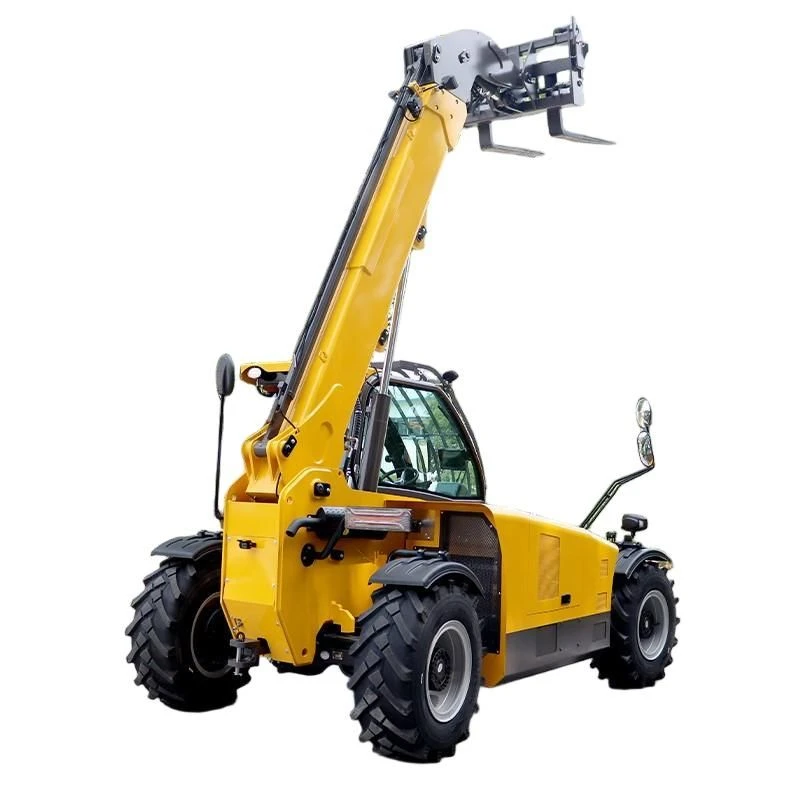
As a telescopic handler supplier, we offer a great range of machines with different steering systems to suit various needs. One of our popular models is the FT35 Telescopic Forklift. It comes with an advanced four - wheel steering system that gives it excellent maneuverability. Whether you're working on a small construction site or a large agricultural farm, the FT35 can handle it all.
The steering system of the FT35 is designed for maximum efficiency. The hydraulic steering system is responsive and easy to operate. The operator can switch between different steering modes quickly, depending on the job at hand. And with its compact design and powerful steering, the FT35 can get into places where other machines can't.
If you're in the market for a telescopic handler, it's important to consider the steering system. Think about the type of work you'll be doing. If you're mostly working in open areas, two - wheel steering might be sufficient. But if you need to work in tight spaces, four - wheel steering or crab steering could be a game - changer.
We understand that every customer has different needs. That's why we're here to help you choose the right telescopic handler with the perfect steering system for your job. Whether you're a small business owner or a large construction company, we've got the solution for you.
If you're interested in learning more about our telescopic handlers and their steering systems, or if you want to discuss a potential purchase, don't hesitate to reach out. We're always happy to have a chat and help you find the best machine for your needs.
References:
- Industry knowledge and experience in the telescopic handler field.
- Technical specifications of telescopic handlers.


